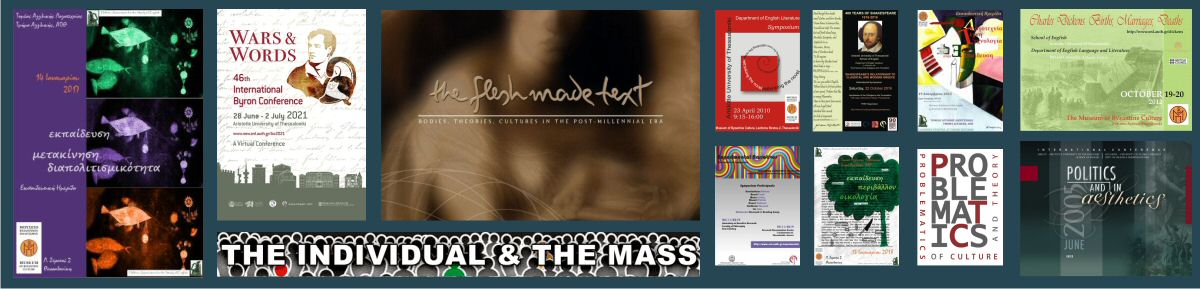
The “Problematics of Culture and Theory” Seminar, held by the School of English at Aristotle University, will be hosting an in person talk by Dr. Tamta Amiranashvili on Thursday, 22nd October, 2026, at 14.00 (14.00-15.15) in room 417 Junior.
The title of the online talk is: Margaret Atwood's Oryx and Crake - Posthumanist Reality in the Biotechnological Era
All those interested in attending, please submit the relevant registration form.
Problematics Seminar Coordinators
Dr L.E. Roupakia (roupakia@enl.auth.gr) and Dr Ε. Botonaki (botonaki@enl.auth.gr)
EVENT ABSTRACT
This paper examines Margaret Atwood's 2003 novel Oryx and Crake through the lens of biotechnological development and posthumanist theory. This literary work describes a dystopian future where genetic engineering has fundamentally altered human genetic code and blurred the traditionally sharp boundary between natural and artificial. Through detailed text analysis, it becomes clear that Atwood's narrative simultaneously serves as both a warning and a critique of humanity's rapid technological development trajectory, particularly regarding genetic modification and corporate biopower issues.
The character Crake embodies posthumanist ambition—a scientist who creates a new species to replace flawed humanity—while protagonist Jimmy/Snowman presents a nostalgic human perspective, caught between old and new worlds. Through analysis of the relationships between Crake, Jimmy, and the genetically modified 'Crakers' presented in the novel, the study reveals Margaret Atwood's vision regarding complex issues such as human essence, establishing boundaries between species, and biotechnological ethics.
Ultimately, Oryx and Crake reveals deep concern about biotechnology's potential to transform and, moreover, assume the role of God and completely recreate humanity. At the same time, the writer critiques the environmental and social complexities that might trigger such radical posthumanist scenarios as world destruction and repopulation of Earth with new posthuman species—the 'Crakers.' The novel is not a simple moral judgment of current events; the writer has much to contemplate about human characteristics and those features worth preserving in a posthumanist world.
GUEST SPEAKER
Dr. Tamta Amiranashvili is a scholar of English literature from Kutaisi, Georgia. She received her PhD from Akaki Tsereteli State University in 2019. As part of her academic and professional development, she studied at St. Catherine University in the United States and the University of Graz in Austria.
Since 2013, she has been working at Akaki Tsereteli State University, where she is currently an Assistant Professor of English Literature. Her research interests focus primarily on twentieth- and twenty-first-century literature, with a particular emphasis on dystopian fiction, posthumanism, and representations of technology and the future in contemporary literature.